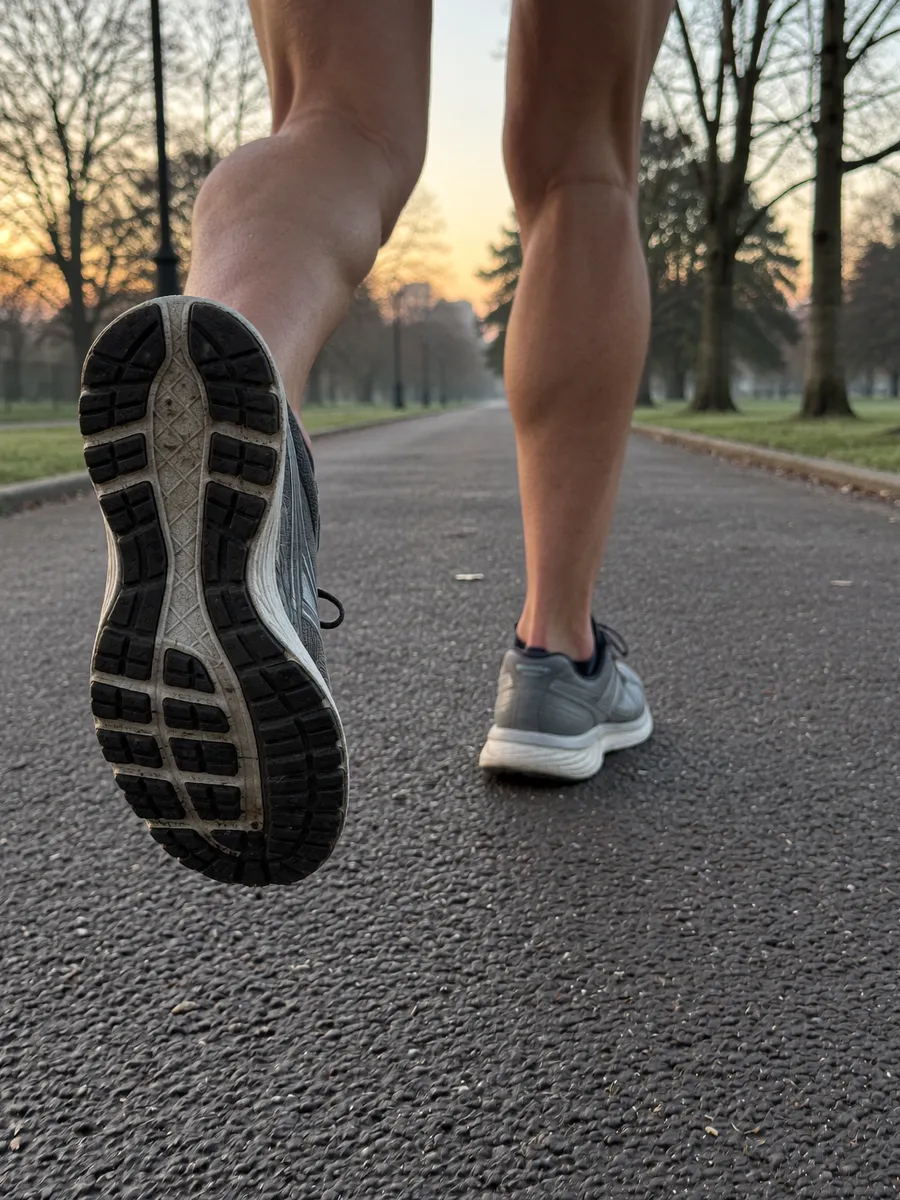
First marathon over 40
Your First Marathon After 40
The 18-week plan built on 3 runs a week, so you reach the finish line healthy, not wrecked.
- 3 runs + 2 short strength sessions a week
- No 20-milers you don't need
- Fueling, race week, and every "what if"
- Your plan on your own dates, in your phone's calendar
A look inside


38 pages · US Letter · prints well, reads fine on a phone
The GUS principle
Grateful. Unhurried. Smiling.
Every rule in the plan comes back to one of these three words.
Grateful the why
Your body still says yes to 26.2 miles after 40. So you treat it that way: a doctor's green light before week 1, a 0–10 rule for when something hurts, and your reason to run written down before race day.
Unhurried the how
Easy runs you could hold a conversation on. Long runs capped at 3½ hours. Cutback weeks you never skip. And a race start that feels embarrassingly slow for the first three miles.
Smiling the spirit
In a study of 24 runners, they used less oxygen at the same pace when they smiled than when they frowned. You practice it on long runs, with your own mantra, and with your people waiting at miles 18–22.
Chapter 1 of the guide turns each word into things you do in training.
This plan fits you if…
- You're 40 or older and aiming for your first marathon (or your first in a long time).
- You want to finish strong and healthy, not qualify for Boston.
- You can run 3 days a week, plus two 20-minute strength sessions.
- You can already run 30–45 minutes without stopping.
Not there yet?
Don't start week 1 early. The guide shows you how to spend 6–10 weeks building to a comfortable 4-mile run first. Run/walk is fine.
Chasing a fast time?
This isn't that plan. It's built for finishing well on modest mileage.
What's inside
- Before you start. Who it's for, and the three questions to ask your doctor first.
- The GUS principle. Grateful, unhurried, smiling: the three words behind every rule in the plan.
- What changes after 40. Recovery, muscle, tendons, and sleep, and what doesn't change.
- For women over 40. Perimenopause, menopause, iron, bones, and pelvic floor.
- Choosing your first marathon. Time limits first, with 9 races checked for slower runners.
- Your week. 3 runs and 2 strength sessions, and how to fit them around real life.
- How hard is "easy"? The talk test, and heart-rate zones if you like numbers.
- Running form and breathing. Four simple cues, and no forced forefoot striking.
- The 18-week plan. Run or run/walk, in miles with km, capped at 3½ hours.
- Strength. 2 × 20 minutes that protect your running.
- Fueling. Gels per hour, sodium, carb loading, and race-morning breakfast.
- Gear that matters. Shoes, watch, clothing, and what's a waste of money.
- What if… Missed weeks, travel, illness, heat, the treadmill.
- Aches and pains after 40. Where it hurts, what to do first, and when to see a pro.
- Mental energy. Keep smiling when it's hard: self-talk, mantras, and your support crew.
- Race week and race day. The checklist, two timekeepers, miles 18–26, and the two weeks after.
- Your training log. Print it and put it on the fridge.

Included with the guide
Your plan, on your dates
Enter your race date, and all 18 weeks land on real days. No app to install.
- In your phone's calendar: every session, and it moves with you if your race date changes.
- An email every Monday with the week's sessions and the tip from the guide that fits it.
- Tick off each session and rate how the week felt, like the log in the guide.
- "What if…" answers one tap away: a missed run, a cold, a niggle, a busy week.
Long runs on Saturday or Sunday, continuous or run/walk.

Written by Romain
The guide I wish I'd had at 41
I ran my first marathon in Lucerne in 2023, at 41. I trained with a generic app plan and made it to the finish. On the way I learned a few things the hard way: a field that ran off faster than me, gels my stomach refused, and a knee that hurt for two weeks before the race. Afterward, I could barely walk. I'd torn ligaments.
I'm not a professional coach. This guide is built for bodies over 40, and every number in it was checked against published research and official race pages. I wrote it with the help of AI tools. The runner photos are AI-generated; the photos of me are real (in one, AI removed a reflection from my sunglasses). It's general education, not medical advice.
Start your 18 weeks
One payment. Instant download, plus your plan on your own dates. Yours to keep and print.
Free
The race-week checklist
What to do 7 days out, 3 days out, the night before, and on race morning. One page, printable.
Ran it? Tell us how it went.
Finished your first marathon with the plan, got stuck in week 9, or found something we should explain better? Write to hello@marathonwithgus.run. We read every email, and your feedback shapes the next edition. We only share a story with your permission, with your first name and age.
Questions about your first marathon after 40
Is 3 runs a week enough to train for a marathon?
Yes, for a first marathon where the goal is to finish strong and healthy. The plan makes each run count: one easy run, one quality run, and one long run that grows slowly to 18–20 miles or 3½ hours. Two short strength sessions protect the tendons and muscles that take longer to recover after 40.
How long does it take to train for a marathon after 40?
The plan takes 18 weeks. You should be able to run 30–45 minutes without stopping before week 1. If you can't yet, the guide shows you how to spend 6–10 weeks building up first, and run/walk is fine.
What exactly do I get?
A 38-page PDF (US Letter). Download it right after paying; we also email you the link. Distances are in miles, with km alongside. You also get a private plan page: enter your race date and the 18 weeks land on real dates, in your phone's calendar, with the week's sessions by email every Monday and a log to tick off.
I'm 55 (or 65). Is it too late?
No. Every big marathon has thousands of first-timers in their 50s and 60s. The plan is built around the recovery and strength work that matter more with age. Get a green light from your doctor first; chapter 0 tells you what to ask.
Is this medical advice?
No. It's general training education. If you have a heart, lung, joint, or metabolic condition, or take medication, talk to your doctor before you start.
What if it's not for me?
Email hello@marathonwithgus.run within 30 days and you'll get a full refund.
I lost my download link.
Enter your email here and we'll send a fresh one.
Who's behind this?
Romain, who ran his first marathon in Lucerne in 2023 at 41, wrote the guide with the help of AI tools. The runner photos are AI-generated; the photos of Romain are real, with one sunglasses reflection removed using AI. It's published by Die Digitalen GmbH, a small company in Zürich, Switzerland. Payments are handled by Stripe, which also takes care of sales tax.